Texas
giant-sized skull:
Now confirmed by the university records!
 A
newspaper article from 1940 tells that a giant-
sized
skull was fund in Texas. I have now received confirmation
from the University of Texas that a large skull was found
in the Morhiss mound in 1939 but that the
skull
has
been missing
from
the
collection
for a long time. A
newspaper article from 1940 tells that a giant-
sized
skull was fund in Texas. I have now received confirmation
from the University of Texas that a large skull was found
in the Morhiss mound in 1939 but that the
skull
has
been missing
from
the
collection
for a long time.
The
article from 1940:
Beach
Giant Skull Unearthed By WPA Workers Near Victoria
Believed
to Be Largest Ever Found in World; Normal Head Also
Found
That
Texas "had a giant in the beach" in the long
ago appears probable from the large skull recently unearthed
on a mound in Victoria County, believed to be the largest
human skull ever found in the United Estates and probably
in the world.
Twice
the size of the skull of a normal man, the fragments
were dug up by W. Duffen, archeologist who is excavating
the mound in Victoria County under a WPA project sponsored
by the University of Texas. In the same mound and at
the same level, a normal sized skull was found. The
peices taken from the mound were reconstructed in the
WPA laboratory under the supervision of physical anthopologists.
A
study is being made to determine whether the huge skull
was that of a man belonging to a tribe of extraordinary
large men, or whether the skull was that of an abnormal
member of a tribe, a case of gigantism. Several large
human bones have been unearthed at the site.
Marcus
B. Goldstein, physical anthropologist, employed on the
WPA project, formerly was an aide of Alen Horliken,
curator of the National Museum of Physical Anthropology.
Finds
made through excavations in Texas are begining to give
weight to the theory that man lived in Texas 40,000
years ago, it is said. |
 |
|
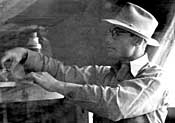
William
A Duffen
|
 |
|
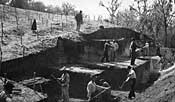
Morhiss
Mound digging
|
 |
|
Mammoth
molar!
|
|
 |
From
The Victoria Advocate - Aug 22, 1974 (here):
The
Morhiss Mound , which measured 15 feet hight
by 319 feet long and 168 feet wide in the middle
was found approximately seven miles southeast
of Victoria on land owned at the time by Patrick
Welder and Tom Joshua. It was set back from
the Guadalupe River about 250 feet in a jungle-like
underbrush.
Work began on the Morhiss excavation in June
of 1932 and lasted for most of the summer with
at least 10 separate burial findings within
the mound, and some 36 perfects artefact specimens
being collected.
Probably the most
unique find of any expedition in the area was
at the Morhiss Mound when an undergraduate student
unearthed the complete skeleton of a man that
could well have been called giant. Though no
specific figures were given on the size of the
skeleton, photos of the head show it to be almost
twice the size of a normal skull.
|
 |
From
another newspaper:
"Texans,
back in 38.060 B.C., had big heads, WPA Victoria
CO, archeological find shows. Dug from Morris
mound, abnormal size of larger skull is shown
in comparison with normal skull." |
|
There
are many stories on the internet about remains after ancient
giants found many places in the world but it is difficult
to get confirmation that these findings actually took place.
Well, I have found many old newspaper articles in the New
York Times' archives telling about giant bones and skulls
found in mounds in the USA. Often the ancient bones crumbled
to dust when exposed to air but some were more solid and reportedly
taken to nearby universities or museums. I have been trying
to get confirmation from the museums and universities, and
the first came from the Humbolt Museum in Winnemucca: They
do have one of the Lovelock-giants skulls.
Morhiss Mound
Most of the newspaper articles are from the last part of 1800
to very early 1900, so it might be hard to find the correct
person to contact but one article is from 1940: The San Antonio
Express is telling about a giant skull that is twice the size
of a normal skull - and there is also a picture. I have managed
to get in touch with the University of Texas at Austin and
they have been kind enough to search their archives. They
found papers telling that there was a large scale archaeological
excavation at the so called Morhiss Mound, situated by the
Guadalupe River not far south of Victoria in Texas. After
an initial correspondence I received an e-mail from Carolyn
Spock who is head of records at the Texas Archeological Research
Laboratory at the university:
"The particular specimen that you ask about, the large
skull found at the Morhiss site in 1939, is noted in our paperwork
as missing from the collection (and has been for some time,
not appearing in inventories undertaken since the collection
arrived at TARL)."
Prehistoric groups
The
archaeologists today believe that the Morhiss Mound was a
major campsite where prehistoric groups stayed at times and
also a burial ground for at least 5.000 years. The first to
excavate the place believed that it was a man-made mound similar
to mounds found so many other places in the USA but today
it is said to be made
up of debris naturally deposited from the
river.
Never
fully analyzed
The site was excavated by archaeologists from the University
of Texas during a preliminary dig in 1932 and a large scale
excavation in 1938-1940. The person to lead the latter was,
as the newspaper article tells, the archaeologist William
A. Duffen. He had a large team of 30-40 WPA-paid workers with
him and even if the excavations were well done by the standards
of the day, the fieldwork
concluded on the eve of World War II, and
the site has never been fully analyzed and properly reported.
Early
Man
During the excavation
the team found a lot of interesting objects like stone tools,
knives, arrowheads, unworked flint cobbles and marine shells.
Plus human
bones, Duffen estimated at least 219 burials could be documented,
representing
at least 250 individuals. They
also found fossilized bones of extinct animals, and that raised
the question if Early Man of North America could have coexisted
with now-extinct beasts!
Did
it exist?
But what about the skull of large size? Did it exist at all?
Well, physical anthropologist Marcus S. Goldstein
says in his manuscript; "A couple of unusual crania were
unearthed at Morhiss Mound in Victoria County. One of these,
although much mended and its base quite warped, is nevertheless
obviously a skull of extraordinary size, in many respects
larger than any yet reported."
And
it was not only one for he added: "Moreover, other crania
from the same site approximate the skull in question. Hence,
it is my
opinion that this exceptionally large skull was not the result
of endocrine pathology."
Extraordinary
size
The museum recorded the finding of a large skull in the Morhiss
Mound and one of the anthropologists wrote in his report that
it was of extraordinary size. But the skull is gone and in
all other papers you will find no mentioning of a human skull
of giant proportions - not even
in Duffen's reports, though he does say that the "skull
seems large"
and that he "looks like a large individual to begin with."
The head of records at the university is of the opinion that
the story might have been blown out of proportion, that it
might have been the head of a robust person but not out of
the ordinary. Well, to me it seems that the picture in the
newspaper indeed is showing a skull of extraordinary size.
But where is it?
From: Carolyn Spock
[mailto:c.spock@mail.utexas.edu]
Sent: 10. February 2010 07:03
To: Terje Dahl
Regarding: SV: Giant human skull
Chris Cooke sent your request for information about
the WPA excavations near Victoria to our facility, as
the Texas Archeological Research Laboratory (TARL) holds
some WPA materials. The particular specimen that you
ask about, the large skull found at the Morhiss site
in 1939, is noted in our paperwork as missing from the
collection (and has been for some time, not appearing
in inventories undertaken since the collection arrived
at TARL). I did check the reports that mentioned human
remains (the authors were cited in the Texas Beyond
History webpages) and none of them noted encountering
an abnormally-sized skull.
As a point of policy, most
U. S. museums no longer have exhibits that include
Native American human remains. The only time that
this skull from Morhiss may have been on display was
in the exhibit that the WPA lab arranged while the
excavations were underway.
You asked about relevant information;
I can only cite the early observations, as there are
no new studies on that particular skull.
Physical anthropologist Marcus
S. Goldstein says in his manuscript, "A couple
of unusual crania were unearthed at Morhiss Mound
in Victoria County. One of these, although much mended
and its base quite warped, is nevertheless obviously
a skull of extraordinary size, in many respects larger
than any yet reported. The bones of this individual
do not indicate excessive stature, but they are remarkably
robust and plainly point to a very muscular man. The
possibility of abnormality, perhaps an endocrine disturbance,
arose immediately, but the largeness of the skull
seems to be symmetrical, the hand bones do not show
the 'knobbing' typical of acromegaly, and stature
was evidently in no wise unusual. Moreover, other
crania from the same site approximate the skull in
question. Hence, it is my opinion that this exceptionally
large skull was not the result of endocrine pathology."
I hope this provides sufficient
information.
Carolyn
~~~~~~~~~~~~~~~~~~~~~~~~~~~~~~~~~
Carolyn Spock
Head of Records
Texas Archeological Research
Laboratory
The University of Texas at Austin
1 University Station, R7500
Austin TX 78712-0714
512.471.6006 voice 512.471.5973 fax
www.utexas.edu/research/tarl
www.texasbeyondhistory.net/
|
From: Carolyn Spock
[mailto:c.spock@mail.utexas.edu]
Sent: 10. February 2010 08:14
To: Terje Dahl
Regarding: Re: Giant human skull
It would appear that the post-cranial
material wasn't out of the ordinary, though definitely
robust. No extra digits were noted in Duffen's field
form for the burial, though he does say that the "skull
seems large" and that he "looks like a large
individual to begin with." Goldstein mentions
the lack of "knobbing" in the hand bones
in his description; I'm sure extra fingers would have
been noted.
The unusual can certainly be
blown out of proportion; the last paragraph in the
newspaper article stating that finds "in Texas
are beginning to give weight to the theory that man
lived in Texas 40,000 to 45,000 years ago" is
fantastical even today.
Carolyn
|
Read
more about the Morris Mound at Texas Beyond History:
http://www.texasbeyondhistory.net/morhiss/index.html
|