 Giants
and science: Giants
and science:
Is it so sure that the giants do not fit the theory of human
evolution?
For
hundreds of years it was believed that giants once had roamed
the earth. This all changed when Charles Darwin in 1859
presented his theory saying that natural selection was the
cause of evolution: Humans had evolved from apes. The giants
of the Bible were suddenly nothing but theology, and the
legends all over world just fiction. Well, not everybody
was impressed; there is still a fierce debate between the
creationists and evolutionists. And archaeological findings
and DNA-testing are bringing questions to the accepted theory
of human evolution. So let's take a closer look!
|
|
Ardipithecus
ramidus:
4,4 million years ago
120 cm (3'11") tall
Brain: 300-350 cm³

|
|
|
|
Homo
erectus:
1.5 million years ago.
1.79 m (5
ft 10 in)
Brain 850-1100 cm³ 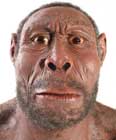
|
|
|
|
Homo
heidelbergensis: 600.000-400.000 years ago.
1.8 m (5ft 11in)
Brain
850-1200 cm³ 
|
|
|
|
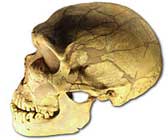
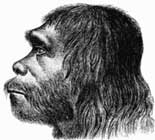
Homo
neanderthalensis: 600.000–20.000
years ago
1.64 m (5 ft 5 in)
Brain 1.125-1.750 cm³
|
|
|
|
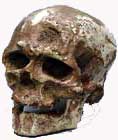
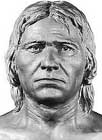
Early
Homo sapiens
35.000-10.000 years ago
1.70 m tall (5 ft 6 in)
Brain 1.200-1.600 cm³
|
|
|
|
Homo
sapiens
sapiens
200.000 years ago to now
Brain: 1250cm³

|
|
The
scientists of today believe that the earth was formed 4.5
billion years ago and that life appeared on its surface within
one billion years. As we can read in Wikipedia: "Highly
energetic chemistry is believed to have produced a self-replicating
molecule around 4 billion years ago and half a billion years
later the last common ancestor of all life existed."
It is also believed that several million
years ago an African ape-like animal gained the ability to
stand upright. This enabled the use of tools - and it was
a need for a larger brain, which started the evolution of
the human race.
DNA-testing has shown that the closest living
relatives of humans are gorillas and chimpanzees, as they
share a relatively recent common ancestor. Human DNA is about
94-98 percent simular to that of chimpanzees.
"Wise man"
"Homo sapiens" is Latin for "wise man"
and we humans are, as far as the scientists know, the only
living species of the Homo genus. The accepted theory is that
anatomically modern humans originated in Africa about 200.000
years ago - and that migration out of Africa occurred about
70.000 before present time. These modern humans spread globally
and replaced earlier hominids. A popular theory is that they
displaced Homo Neanderthalensis and other species descended
from Homo Erectus (which had inhabited Eurasia as early as
2 million years ago) through more successful reproduction
and competition for resources. The humans shall have reached
full behavioural modernity around 50.000 years ago, when language,
music and other cultural universals had developed.
It is believed that these modern humans
inhabited Eurasia and Oceania for about 40.000 years ago and
the Americas at least 14.000 years ago. About 6,000 years
ago, the first proto-states developed in Mesopotamia, Egypt's
Nile Valley and the Indus Valley.
The
"gigantes"
Giant. The word has its origin from Greek mythology: The "gigantes"
were the children of the goddess Gaia, the mother of all.
The Titans was a result from her union with Uranus while other
giants were fathered by Taranus.
The most famous of the giants were the hundred
Thracian Gigantes who waged war on the gods. The ancient Thracians
inhabited areas including Thrace in Southeastern Europe. Thrax,
where the name Thrace comes from, was regarded as one of the
sons of the violent god Ares. There were
many other giants, including the handsome Orion, the one-eyed
and cannibalistic cyclop Polyphemus, and the six-armed Gegenees
(for an article with a complete list of giants from Greek
mythology - click here).
The giants of the Greek mythology were really
tall; Herodotus describes how the Spartans uncovered in Tegea
the body of Orestes which was seven cubits long - around 10
feet (3.30m) and Ajax, great-great-grandson of the god Zeus,
was said to have been almost 14 feet (4.3 meters).
Other giants in mythology
The English word "giant" is derived from Greek "gigantes",
and the mythology and legends of many different cultures include
monsters of human appearance but with enormous size and strength.
In Hinduism, the giants are called Daityas,
they were the children of the earth goddess Diti and the sage
Kashyapa - and they fought against the gods or Devas because
they were jealous of their Deva half-brothers.
The giants are the origin of many of various
monsters in Norse mythology, but the gods themselves were
related to the giants by many marriages and they bear little
difference in status to them. Norse mythology also tells that
the entire world of men was once created from the flesh of
Ymir, a giant of cosmic proportions. His name is considered
by some to share a root with the name Yama of Indo-Iranian
mythology. In Vedic tradition Yama was considered to have
been the first mortal "who died and espied the way to
the celestial abodes".
In Bulgarian mythology, giants called ispolini
inhabited the Earth before modern humans. They lived in the
mountains, fed on raw meat and often fought against dragons.
Many legends in the Basque territory in
Spain tell that the giants are accountable for the creation
of many megalithic structures like dolmen. Yes, in folklore
from all over Europe, and also all over the world, giants
were believed to have built large walls and other gigantic
stone monuments; That the megaliths were made by previous
civilizations where the giants played an important part.
Fairy tales
Tales of combats with Celtic giants were a common feature
in the folklore of Wales, Scotland, Ireland and England. Giants
also figure in a great many fairy tales, such as Jack and
the Beanstalk. Ogres and trolls are humanoid creatures, most
often of gigantic stature, that occur in European folklore
and fairy tales.
The Bible
In the Christian Bible we can read: "There were giants
on the earth in those days; and also after that, when the
sons of God came in unto the daughters of men, and they bare
children to them, the same became mighty men which were of
old, men of renown." Genesis 6:4.
The most famous giant in the Bible is of
course Goliath, he was as "six cubits and a span"
in height - over nine feet tall (over 2.75 m). Goliath had
six fingers on each hand and six toes on each foot. He was
far from the only giant in the Bible, but they were of a dying
race. King Og was said to have been the last - his bed was
13 feet long!
Sumerian
The Sumerian culture is said to be the oldest in the world;
where civilization was born. The old Sumerians believed that
their gods came from the stars and that it was these god that
helped them to change their ways of living: The gods taught
them everything from farming to fishing, building hoses and
writing on clay tablets - even mathematics based on the six
digits system. Sumerian pre-historic statues, seals and carvings
are often showing their gods and the children they got with
the humans - giants with six fingers!
1.20 meter tall monkeys
We
have had a brief glance at mythical giants from the Greek
titans to the Sumerian gods, but even if they in the ancient
scriptures were described as real there is no proof that they
actually were living beings. Let us go back to science; what
about the ancient humans, the first Homo Sapiens and even
earlier? Could some of them have been giants? Well, as we
have mentioned: according to the theory of evolution; the
human race started out as 1.20 meter tall monkeys that got
the ability to stand straight up, about 5 million years ago.
1.5 million years ago we had developed from this "apeman"
Ardipithecus Ramidus to Homo Erectus, who was in average 1.79
meter (5 ft 10 in) tall - and then about half a million years
ago to Homo Heidelbergensis, who was a centimetre taller or
so. The Neanderthal man, Homo Neanderthalensis who lived 600.000
to 20.000 years ago was quite a bit shorter with 1.65 meter
in average (but had a larger brain than we have today). The
Early or Archaic Homo Sapiens, like Cro-Magnon, lived 35.000-10.000
years ago and were in average 1.70 meters tall (5 ft 6 in)
for males. So we find no giants in our earliest history -
according to the most accepted theories!
| Click
on the pictures for articles or info! |
A
different picture of the human early evolution
Professor
Lee Berger
of the University of Witwatersrand in
 |
|
Berger
holding bone
|
 |
|
Meganthropus
|
|
|
|
Bigfoot
|
| |
South
Africa is giving us quite a different
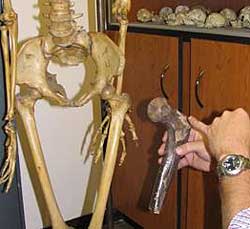
picture of the early human evolution: He says that numerous
fossil bones indicate some populations of Homo Heidelbergensis
were "giants", routinely over 2.13 m (7 ft) tall
and inhabited South Africa between 0.5 million and 300,000
years ago. Some of them were even much taller! At least one
archaeologist refutes Bergers claim but there are pictures
of Berger holding a giant bone in front of normal sized bones
- and there is no doubt that it is much larger!
I
guess you never have heard about Homo Palaeojavanicus
or Meganthropus. It is a name given to several large jaw and
skull fragments from Sangiran, Central Java. Most paleoanthropologists
considering them related to Homo Erectus in some way, and
some of the finds were accompanied by evidence of tool-use
similar to that of Homo Erectus. Homo
Meganthropus is estimated ta have been 2/3 the size of Gigantopithecus
(see next), which was twice as large as a gorilla, which would
make it somewhere around 8 feet (2.44 m) tall.
Gigantopithecus
or Gigantopithecus Blacki is
said to an extinct species of ape and it is believed that
an adult male stood about 3 m (9.8 ft) tall and weighed as
much as 540 kilo. Dating methods have shown that Gigantopithecus
have been contemporary with Homo Sapiens for tens of thousands
of years, and co-existing with Homo Erectus before the appearance
of Homo Sapiens. In the past, it had been thought that Gigantopithecus
was an ancestor of humans, on the basis of molar evidence
- and some researchers still claim that the footprints are
simular to that of humans and not apes. Some say that Bigfoot/
Sasquatch/Yeti are forms of Gigantopithecus that live in remote
areas today!
New
species of human
 |
|
Denisovan
tooth
|
Resent
findings and DNA-testing have given startling results and
unexpected conclusions. In March 2010 scientists announced
the discovery of a finger-bone fragment and a tooth in the
Denisova Cave in Altai Krai, Russia. The bones had belonged
to an ancient human species but DNA-analysis showed to their
surprise that it was a new species of human and gave this
species the name "Denisova hominins".
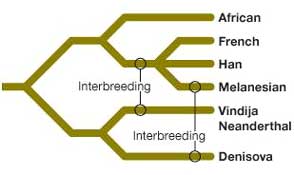
Further studies determined that this group shares a common
origin with Neanderthals and interbred with the ancestors
of Melanesians like in Papua New Guinea and Australian aborigines.
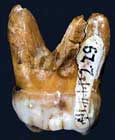
The tooth was gigantic, much larger than any Homo Sapiens
or Neanderthal teeth ever found!
 |
|
Prof.
Vekua with bones
|
 |
|
Lovelock
jaw and normal jaw
|
Russian
major tv-channel
Another
startling find has recently been done in the Borjomi Gorge
in Georgia, close to the Caucasus Mountains: Bones that belonged
to humans that lived 25 thousand years ago, human giants that
would have been from 2.5 to 3 meters tall (about 9 to 10 feet)!
The expedition was filmed and it was showed as a news item
at the Russian major TV-channel Channel One. The well known
academic Abesalom Vekua shows the bones on the film
and
tells that he believes that the find is a sensation, as in
the scientific
community long has debated if there were giants who inhabited
certain areas of Eurasia thousands of years ago. The bones
were found in a crypt in a ruined and unknown settlement in
an isolated and now uninhabited area.
Very tall people
Humbolt Museum in Winnemucca, USA has confirmed that they
have remains after the so called Lovelock-giants there. In
1911 several
 |
|
Giant stone tools
|
 |
|
The
Texas skull, right
|
giant
skeletons and ancient artefacts were fund in a cave in
Lovelock
in Nevada. Almost everything was later lost in a fire but
you
can still go to the museum to see the giant Lovelock skull!
Several
giant stone tools have been found in the Kalahari Desert of
Africa, and Professor David Thomas of the University of Oxford
has confirmed that four of the
hand-axes they found were more than 30 centimetres long!
Many old articles in the respected newspaper
New
York Times tells
of giant skeletons
that were found all around the USA when the settlers worked
their newfound land, and the University of Texas has confirmed
that a large skull was found in 1939 but that the skull has
been missing from their collection for a long time.
It is also interesting to read how the first
explorers came across very tall people at the southern part
of South America (Patagonia) and that even Darwin in 1931
wrote: "They are certainly the tallest race which we
anywhere saw." Yes, a large skeleton has even been found
in resent times!
 |
|
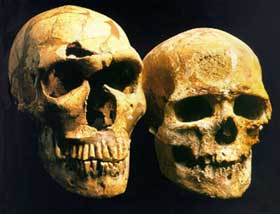
Modern
man and Cro-Magnon
|
The
scientists do not always agree
The archaeologists are doing new discoveries all the time,
and as you have read above: Some of them are quite sensational
when it comes to the size of the earliest humans. The scientists
are of course "a bit" reluctant to use the word
"giant" - even when they discover teeth or leg-bones
that only could have belonged to a homo of gigantic size!
What also is interesting is that we are getting an increasing
variety of ancient human species all the time: We already
have about 20 different species of homo! For ordinary people
this can be hard to understand - and it seems to be quite
confusing for the scientists as well: They seem at the least
to have as many views on our earliest past as they have species
of homo!
 |
|
Resent analysis indicates that
modern humans, Neanderthals, and the Denisovans shared
a common ancestor but it still seems to be unclear
if any of the homo species were tall enough to be
called giants - but it is not impossible! What is
sure is that new archaeological findings and DNA-testing
are bringing new questions to the accepted theories
of early human evolution!
|
It is also a bit strange that the term Cro-Magnon has been
eradicated from the scientific papers and books and substituted
the general term Early or Archaic Homo Sapiens. Cro-Magnon
was considered to be the tallest of the homo-species, generally
more than 7 feet tall, but today Early or Archaic Homo sapiens
is said to only have been as tall as modern people - as you
and me. A few illustrations comparing Cro-Magnon with Homo
Sapiens can still be found on the internet - and the difference
in hight is startling! It is not only Cro-Magnon that seems
to suddenly have shrunk, the Neanderthal man, Homo Neanderthalensis,
is now said to have been an average of 1.64 meters tall: Earlier
he was said to be taller and more muscular than Homo
| Homo heidelbergensis — sometimes
called Homo rhodesiensis — is an extinct species
of the genus Homo which lived in Africa, Europe and
western Asia from at least 600,000 years ago, and may
date back 1,300,000 years. It survived until about 200,000
to 250,000 years ago. Its brain was nearly as large
as that of a modern Homo sapiens. It is very likely
the direct ancestor of Homo sapiens (in Africa) and
the Neanderthals (in Europe), and perhaps also the Denisovans
(in Central Asia). Wikipedia
|
Sapiens.
Of course new and better research can have given other figures
than earlier, and that the figures we have today are the correct
ones. We must also remember that skeletal remains very often
just are small pieces of bone - it is not so that the archaeologists
dig up whole skeletons that can be easily measured! But it
is still a bit worrying that data for earlier findings have
been changed when it comes to hight - especially when it comes
to Homo Species that was said to have been very, very tall!
The tall Archaic Homo Sapiens and Denisovans died out when
we the modern humans entered the stage about 200.000 years
ago. Or is our pre-history wrong? Did they survive for thousands
of years, might be even up to historic times in remote parts
of Siberia and Caucasus mountains? Did they have their own
evolution, did learn how to sail on the rivers and oceans?
Were they the giants of the myths and legends all over the
world?
We
will try to find some answers in the next article!
What
do you think?
Do
you have any ideas, thoughts or facts - please send them
to Terje Dahl: terje@sydhav.no
Here
are what our readers have sent in:
It's such a good article. do you guys have any clue
how was de appereance of the denisovans? (we known there's
no skeeton but based on the proximity of hilderbergensis
and in their enviroment in that time, is it possible
to know more about them look? what do you think? https://www.youtube.com/watch?v=bZQxtHJer60
Rondon
Let it not be forgotten, that Dr. Vekua is holding a
"Femur", of a Cerrano-Homo-Nehidelberghgenesis.
So named from Dr.Cerranos 'first' discovery, of a more
giant form, that averaged 7ft. S, based on that and
that Humans often reach 7',5", for this, I cite
Basketballs Yeow Ming and Vladdie Dievots, plus several
actors, with YY syndrom, at 7',4". Ok, my point
is this, if some 'Proto' Neanderthal, @ 7'achieves YY
Syndrome, isn't it possible for one to reach 8'? Ummmmmm,
yes it is, and that's being conservative. My only wonder,
is if a Giganto could cross, with a Homo-Heidelberg?
If so, that would be the answer for all of Sasquatch
sighting variations.
John S.
There is nothing in evolutionary theory to say that
larger statured peoples could not have evolved through
natural selection, as was the case on many occasions
of large statured animals. Whether the large people
went exinct or still survive is a matter of natural
selection. So you should not state that evolution and
the mechanisms of it could not produce large statured
peoples and Darwin never ever said that - he was a devout
Christian after all.
Grant
tallest homo is human being
alexkent
I think after reading some of the comments, people are
paranoid and they think way too much. There were Giants,
no doubt but I if the Giants didn't survive then they
weren't as intellegent. Too bad for the big and stupidest.
Jessica
I think it would rewrite the evolution of upright walking
apes like us, for the general scientific community to
accept this. That is EXACTLY what they don't want. The
existence of large upright walking non humans, I think,
will always frighten most people. I think about the
case for Sasquatch, Yeti and the various forms of upright
'non humans' out there, the thousand of credible reports
from eyewitnesses and the impact that acknowledgement
of their existence would have.
Think about it, logging operations would be devastated,
especially if habitat had to be set aside. Then imagine
the National forests suffering decreased visitation
due to a large. (often times not very pleasant natured)
bipedal 'ape man' living within their boundaries. Besides,
I really think scientists are unwilling to admit their
theories of human evolution and bipedalism were wrong.
Look how they continually swore that Neanderthals were
lumbering idiots who died out and never mated with early
(modern) humans. I am a redhead and there is evidence
that the MC1R gene responsible for red hair was a Neanderthal
mutation. If this is true, then I am living proof of
that lineage, as are a huge majority of living humans
with 'the ginger gene'. I wish they would finally acknowledge
what most of us already know. There are still discoveries
to be made public.
June P.
First of all Giganto reached, upwards of (15)ft. tall,
not 8. Secondly, (everything) else is 100% true! Their
has been a complete cover up about early Giants, in
America. Several investigative shows, have gone to Native
American burial sites, the last I personally saw on
America History Unearthed. In particular, a (8)ft. (6)in.
skeleton, was found, with (two) Native Maidens, each-covering
their faces, and in fetal position, at (it's) feet,
as if they were some kind of offering. I have also researched
authentic photos of a (over) 7 ft. tall hairy,almost
totally rotted Female corpse, and (7)ft. tall rotted
Female corpse, holding her dead baby, once again, both
were covered in hair. I suggest that the females are
hair covered Serrano-Neiheidelbergs, or early pre- Neanderthal.
The other 1/2 foot male, is clearly a Sasquatch, thus
the 'fear' based double Female Virgin sacrifice, at
its feet.
John S.
Cerano Homo Heidelbergensis, 'averaged' (7) foot tall,
that's already a recorded fact, #(1). Cerano Homo Heidelbergensis,
could also 'easily' reach heights of (8) foot, for this,
I simply cite the 'normal' Human height of around (6)ft,
therefore, there are thousands of 'normal' Humans, (at)
or in excess of (7) ft., just look at all of the pro
basket ball players. Cerano was also covered in body
hair, very muscular, barrel chested and thick boned
and around as early as (11,000)years ago, not 300,00!
I do believe that there are two kinds of Creatures called
'Bigfoot', (a), Cerano, at (7), to (8)ft. and a Gigantipithcus,
evolved derivative. Remember, the rare tales of the
Chumash and Salish Natives having their women abducted,
then usually dieing during birth, only to give birth
to a half Cernano looking baby, that massively grows,
only to always die of internal problems. The Ceranos,
have also been filmed in the Caucasus Mountains, to
this very day, secondly, an evolved derivative of Gigantopitchecus,
look it up, for your self, then open your eyes!
phx761
Terje - Love this! Think about this: Every region of
people passed down history, and it was so unbelieveable
we thought it must be a "myth." Giants did
not evolve - they were intelligent by their father's
superior being DNA - Fallen angels. Evolution was only
the Nephilim trying to create a race of peoples by mixing
DNA with animals. They almost completely died in the
Flood of Noah. Noahs sons wives still had the nephilim
gene deep in their DNA, but it was 120 yrs diluted.
But think of this Ham and Cush had sons that were Bigggg...ie.
Nemrod ... the giants appeared again, just not so big
as before the flood. You know Hybrids loose original
qualities as they continue to breed.
Soon the Bible will prove itself true, and correct man's
theories. It is an exciting time to be alive!
BTW - have you seen the Liger?
Jillianne
Tall = Giant, yet the great apes are heavy, squat, not
so tall?
Uncle B
Why nobody never talks something about of russian csaar
Peter the first, as alien. He was 2.3 m high. His bodyguards
were chosen very carefully. One of the most important
parameter was soldier natural hight All his bodyguards
were must be at least 2.05 m height. This is really
was so.
Rein Visk
Large people have been produced in modern time by population
bottlenecks in the same manner that "midget"
populations have been produced on islands.
Tim
Interesting how the giant mammalian species of the Pleistocene
are no more yet they have smaller representatives alive
today. Could the same thing have happened in the genus
Homo?
Tim
An anthropological fact usually ignored is that there
are notable differences in types of paleolithic man.
The terms Cro-Magnon and Modern Man are used as if they
were synonymous, whereas strictly speaking they are
not. All Cro-Magnons are Modern, but all Moderns are
not Cro-Magnon.
Milo
Homo sapiens may not have pushed Neanderthals to extinction,
as some scientists have hypothesized; it may have been
the weather that did them in. Volcanic eruptions thousands
of years ago devastated Neanderthals in Western Asia
and in Europe, anthropologists report in Current Anthropology.
Sindya
Bhanoo, New York Times
News from the editor:
Between about 20,000 and 5000 years ago, our planet
underwent an astonishing climatic transformation.
Over the course of this period, it flipped from
the frigid wasteland of deepest and darkest ice
age to the - broadly speaking - balmy, temperate
world upon which our civilisation has developed
and thrived. During this extraordinarily dynamic
episode, as the immense ice sheets melted and
colossal volumes of water were decanted back into
the oceans, the pressures acting on the solid
earth also underwent massive change. In response,
the crust bounced and bent, rocking our planet
with a resurgence in volcanic activity, a proliferation
of seismic shocks and burgeoning giant landslides.
Read
more in Sydney Morning Herald.
Childbirth is complicated in humans relative to
other primates. Unlike the situation in great
apes, human neonates are about the same size as
the birth canal, making passage difficult.
A significant shift in childbirth apparently occurred
quite late in human evolution, during the last
few hundred thousand years.
Read
more
The large body size of some Middle Pleistocene
fossil individuals, as well as the Late Pleistocene
Neandertals, has led to considerable speculation
about their adaptation.
Read
more
The average stature of American men today is 176
cm. Holliday [2] showed that early Upper Paleolithic
males had an average stature around 170 cm. According
to Carretero and colleagues, the average Sima
de los Huesos adult male had a stature around
168-170 cm. And as they note, taller individuals
with stature estimates of 180 cm or more are present
in the Early and Middle Pleistocene sample --
most notably the large Kabwe tibia, but we can
also mention KNM-ER 1808 and KNM-ER 736 from the
Early Pleistocene of Kenya.
Read more
Many dramatic changes in morphology within the
genus Homo have occurred over the past 2 million
years or more, including large increases in absolute
brain size and decreases in postcanine dental
size and skeletal robusticity.
Read more
Ancient Human Fossil Could Be New Primitive Species
During the Pleistocene Epoch, which lasted from
about 2.6 million years ago to 11,700 years ago,
humans generally evolved smaller jaws and teeth,
but the new fossil from Taiwan appears larger
and more robust than older Homo erectus fossils
from Java and northern China.
Read
more
From Wikipedia:
"People have lived in Australia for about
40,000–60,000 years. The first people who
arrived in what is now Australia were the Australian
Aborigines and Torres Strait Islanders.[1] Aborigines
came by boat from the islands of what is now Indonesia."
Melanesians Carry DNA Of Unknown Species - Scientists
Say
Youtube
video
The Out of Europe/Asia & Into Africa Theory
of Human Origins
A new paper published by Professor Úlfur
Árnason, a neuroscientist at the University
of Lund in Sweden, places the last common ancestor
of Homo sapiens sapiens and Neanderthals somewhere
in Eurasia. Árnason argues that the ancestors
of the African KhoeSan and Mbuti populations formed
the first exodus of Homo sapiens sapiens into
Africa from Asia and Europe.
Read
more |
|
|